


Transportation Budget Leader

Curtis King

14th Legislative District
Serving:
Bickleton, Centerville, Finley, Glenwood, Grandview, Lyle, Pasco, Roosevelt, Sunnyside, Toppenish, Wapato, Wishram and Yakima
Senator Mark Schoesler
Legislative District 9
Senator John Braun
Legislative District 20
Senator Curtis King
Legislative District 14
Senator Judy Warnick
Legislative District 13
Senator Phil Fortunato
Legislative District 31
Senator Shelly Short
Legislative District 7
Senator Keith Wagoner
Legislative District 39
Senator Jeff Holy
Legislative District 6
Senator Ron Muzzall
Legislative District 10
Senator Chris Gildon
Legislative District 25
Senator Perry Dozier
Legislative District 16
Senator Jeff Wilson
Legislative District 19
Senator Jim McCune
Legislative District 2
Senator Matt Boehnke
Legislative District 8
Senator Drew MacEwen
Legislative District 35
Senator Nikki Torres
Legislative District 15
Senator Leonard Christian
Legislative District 4
Senator Paul Harris
Legislative District 17
Senator Keith Goehner
Legislative District 12

Tag Archives: Washington State Patrol

Legislature passes bipartisan transportation budget that creates jobs, invests in preservation

The Legislature passed the bipartisan 2025-27 supplemental transportation budget Thursday, a plan that could create up to 30,000 jobs through increased investments in preserving and maintaining the state’s infrastructure.

The balanced, $16.6 billion budget commits funding levels through 2031. In addition to preservation and maintenance, the package prioritizes strengthening the state’s ferry system, improving traffic safety, increasing Washington State Patrol staffing levels, and advancing the state’s climate goals.

“From the start, the budgets proposed by the House and Senate this year have been crystal clear about our commitment to increase funding for preservation and maintenance. I’m proud our final agreement is laser focused on ensuring our roads, bridges, and ferries are working well, all while creating thousands of good-paying jobs for Washingtonians,” said Sen. Marko Liias (D-Edmonds), chair of the Senate Transportation Committee.

“I’m glad the Legislature passed a final version of the supplemental transportation budget today. This budget will allow the state to address many maintenance and preservation projects across Washington, which is crucial to our state’s transportation system. It also provides money to help fix highways that were damaged by last December’s floods,” said Sen. Curtis King (R-Yakima), the ranking Republican on the Senate Transportation Committee.

Funded through a bipartisan bonding agreement, the state will direct $1.3 billion for road and bridge preservation, $200 million for maintenance work, $28 million for ferry preservation projects, and an additional $100 million for safety-focused preservation on mainstreet highways.

Mitigating recent bridge closures and repairing damage from the December 2025 flooding are also key preservation and maintenance priorities in the budget. It allocates $2.5 million through 2029 to support the town of Wilkeson’sinfrastructure and emergency management needs whilethe Fairfax bridge is replaced. The budget also directs $45 million for state and local flood-related highway recovery loans, so infrastructure can be repaired quickly as the state waits for federal disaster funding.

Strengthening and expanding the state’s ferry fleet is a key budget priority as well. The budget fulfills the funding commitment to build the three new ferry vessels under contract for construction by Eastern Shipbuilding Group, and it directs an additional $31 million to fully fund the electrification of three terminals. The budget also allocates $28 million over six years to increase maintenance capacity at Eagle Harbor, increase logistics capacity, and provide for an emergent preservation response team to help return ferries to service more quickly.

Washington’s traffic fatalities are on the decline, and the supplemental budget makes additional investments to keep improving traffic safety in every corner of the state. The budget allocates $2.7 million to the Washington State Patrol to help the agency return to full staffing levels. The proposal also creates a $1 million pedestrian safety grant program for cities and towns to install illuminated crosswalks and directs the Washington State Department of Licensing to develop a website with resources on aging and driving for older drivers and their families.

Building on the state’s work to reduce emissions, promote active transportation, and increase access to affordable public transit, the supplemental budget continues investments in key programs funded through the Climate Commitment Act (CCA), including free transit and ferry fares for youth under 18, Tribal Transit Mobility Grants, and the Safe Routes to School Program.

The three bills comprising the supplemental transportation budget — Senate Bills 6005 and 6225 and House Bill 2711 — now head to the governor for signature.
King supports Senate’s passage of supplemental transportation budget

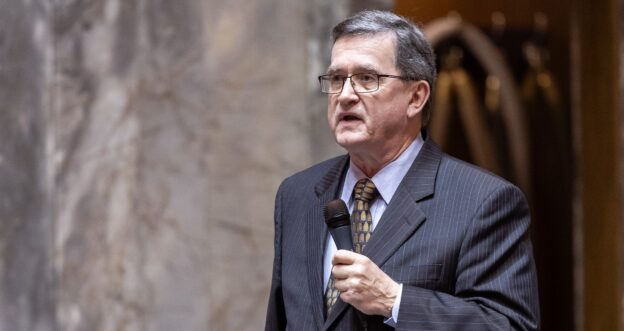
Sen. Curtis King, the Republican leader on the Senate Transportation Committee, says the supplemental state transportation budget passed today by the Senate prioritizes public safety and the maintenance and preservation of roads and highways.

“This transportation budget will help make our roads and highways safer to drive because it makes public safety a priority,” said King, R-Yakima. “Our supplemental budget, along with the 2023-25 state transportation budget enacted last year, provides enough funding to add 194 Washington State Patrol officers over the course of this two-year period. This year’s budget has funding to combat impaired driving, and it provides an additional $150 million for highway-preservation projects across Washington.”

The Senate today voted 48-1 to approve the supplemental transportation budget, which makes adjustments to the two-year budget approved by the Legislature in April 2023.

The Senate supplemental transportation budget spends $14.55 billion, including $8.38 billion in capital spending and $6.17 billion in operating spending. The $150 million in the supplemental budget for preservation projects raises the total amount in the two-year budget cycle for preservation to $1.073 billion.

The budget also provides $150 million in new funding for fish-passage culverts and $77.9 million in additional funding for the State Route 520 west end project in Seattle.

The Senate transportation budget funds several State Patrol projects:

  • $5.9 million for a third trooper class.
  • $4.7 million to restore the money saved when there were trooper vacancies.
  • $289,000 for additional toxicology-lab staffing.
  • $250,000 for staff and resources to improve compliance with ignition-interlock requirements.
  • $250,000 for expansion of licensing investigation unit activities.

The Senate spending plan also funds two public-safety projects for the Washington Traffic Safety Commission:

  • $2 million for a grant program to supplement DUI-enforcement activities.
  • $750,000 for an ignition-interlock dedicated compliance staff pilot program.

The House of Representatives approved its version of the state supplemental transportation budget this past Saturday. Transportation leaders in the Senate and House will meet to resolve differences and reach agreement on a compromise version of the budget.

The 2024 legislative session is scheduled to end March 7.


King says job losses from vaccine mandate will harm public safety, transportation

Amid news that nearly 1,900 state employees have been fired or left their jobs in opposition to Gov. Jay Inslee’s COVID-19 vaccine mandate, state Sen. Curtis King says he is concerned that the state’s transportation system and public safety will suffer in ways that will impact people in his district and throughout Washington.

“We’re already seeing the effects of the governor’s overreaching vaccine mandate on the state ferry system, as the reduction in ferry workers has caused many runs to be canceled and now appear to have just been slashed,” said King, R-Yakima. “Commuters and others who rely on the ferries are being punished because of Jay Inslee’s heavy-handed approach to the pandemic. For example, the San Juan morning runs have been cut from five to two, the times being 4:15 a.m. and 10:35 a.m.”

King said the mandate-related firing of 127 Washington State Patrol employees, including 67 troopers, six sergeants and one captain, is terrible news for those who use the state’s highways.

“Our state troopers do an outstanding job of maintaining safety on our highways and helping motorists and truck drivers when they have an accident or have problems with their vehicles. They save lives,” said King, ranking Republican on the Senate Transportation Committee.

“I saw the video of the trooper based in Yakima who signed off knowing he was about to be fired. The loss of all of these officers, as well as the dispatchers who were fired, will be felt by those motorists who need help on our highways. If and when a motorist is stuck on the side of a freeway or involved in an accident and there is no trooper around to help them, the blame should be placed on the governor.”

King, whose 14th Legislative District includes the Columbia River Gorge and Satus Pass north of Goldendale, has heard that the vast majority of the employees at the Washington State Department of Transportation’s Goldendale maintenance facility have lost their jobs due to the vaccine mandate.

“If there aren’t enough WSDOT maintenance workers to keep Satus Pass and other mountain passes and vulnerable sections of highways open and clear of ice and snow during winter, it will make driving through the mountains extremely dangerous. This could have a very negative impact on drivers and freight hauling throughout Washington this winter, and it could hurt our economy at a time where there are already major supply-chain concerns. Not to mention the safety element and the potential loss of lives,” said King.

Monday was the deadline for most state employees, all school employees and many health-care workers to be fully vaccinated under Inslee’s mandate. King is fully vaccinated and he encourages those who can to be fully vaccinated, but he does not agree with Inslee’s vaccine mandate.

“The governor’s vaccine mandate has already punished the workers who lost their jobs, and it will soon hurt the many of us who rely on the services that were provided by these workers. Governor Inslee is to blame here. He has gone too far with his mandate policy that is leaving many without a job while weakening public safety and transportation across our state. It could have and should have been handled so much differently. He should have given people options. It didn’t have to be this way.”

Sen. King statement on proposed Senate transportation budget

Sen. Curtis King, ranking Republican on the Senate Transportation Committee and R-Yakima, issued this statement on Proposed Substitute Senate Bill 5214, the 2019-21 Senate transportation budget unveiled by Senate Transportation Committee Chair Steve Hobbs on Tuesday:

“This is generally a minimal transportation budget. It doesn’t spend as much as prior budgets, and I plan to support it in committee this week – but with a few concerns. I think we need to take a hard look at the expenses associated with the state ferry system, especially the cost of converting ferries to diesel-electric power. Hydrogen-fueled vessels could be an option and should be considered, but hydrogen wasn’t even looked at.

“Also, this budget covers all of the salary increases for the State Patrol and State Ferries that the governor negotiated. We can’t just keep increasing salaries and expect their salary budgets to remain sustainable and viable. “What I really like about this budget is that it offers some flexibility regarding money that for some reason doesn’t get spent as originally intended. We have said to WSDOT, ‘here is a list of projects that you can move up from the Connecting Washington package if you realized you have monies that you’re not going to be able to spend. These are the projects that you can bring up and continue or complete.’ By doing this, we don’t need to do a big reappropriation at the end of every biennium.”          

Keeping Washington moving forward, Senate passes transpo budget

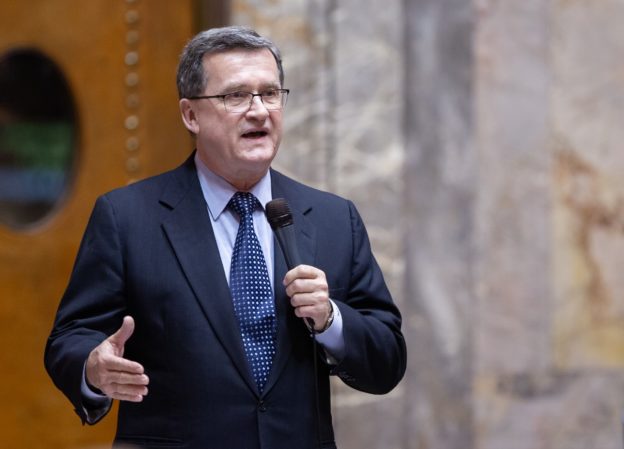
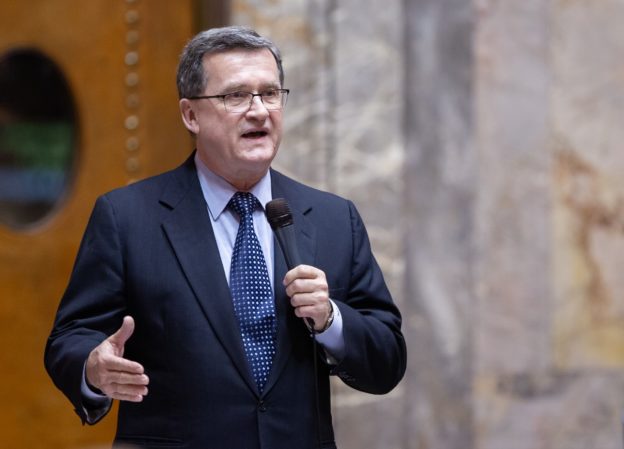
Sen. King speaks in favor of the transportation budget.Sen. Curtis King, R-Yakima, and co-chair of the Senate Transportation Committee, today expressed his thanks and gratitude to members of the Senate and its staff after the unanimous passage of the Senate’s 2013-15 transportation budget proposal. King, along with co-chair Sen. Tracey Eide, D-Federal Way, and fellow budget writers Sen. Steve Hobbs, D-Lake Stevens, and Sen. Joe Fain of Auburn, spoke positively of the bipartisan atmosphere in which the budget was created.

“When a committee has co-chairs with the same authority, the potential for gridlock is increased,” King said, “but Senator Eide has been an extreme pleasure to work with, as have our vice chairs. It’s been an honor to work with these individuals, the other members of the transportation committee, and both partisan and non-partisan staff, without whom none of this would have been possible.”

Continue reading

Bipartisan Senate committee unveils 2013-15 transportation budget

king_120Making good on promises to continue a tradition of cooperation, leaders of the Washington State Senate Transportation Committee today proposed a bipartisan transportation budget that would spend $8.7 billion in 2013-15: $5.3 billion in capital construction spending and $3.4 billion for operating costs and debt service payments. The proposal would complete the tunnel replacing Seattle’s Alaskan Way Viaduct, restore and maintain ferry service levels, and improve or preserve highways across Washington, as well as make a number of system-wide reforms.

“We were faced with a particularly challenging set of circumstances this year, but I’m proud that this committee has not only faced those challenges but overcome them,” said Sen. Curtis King, R-Yakima, and co-chair of the transportation committee. “We’ve been able to maintain funding for all the projects to which the state is already committed, and we’ve even identified a number of areas where we can generate savings by implementing reforms.” Continue reading